
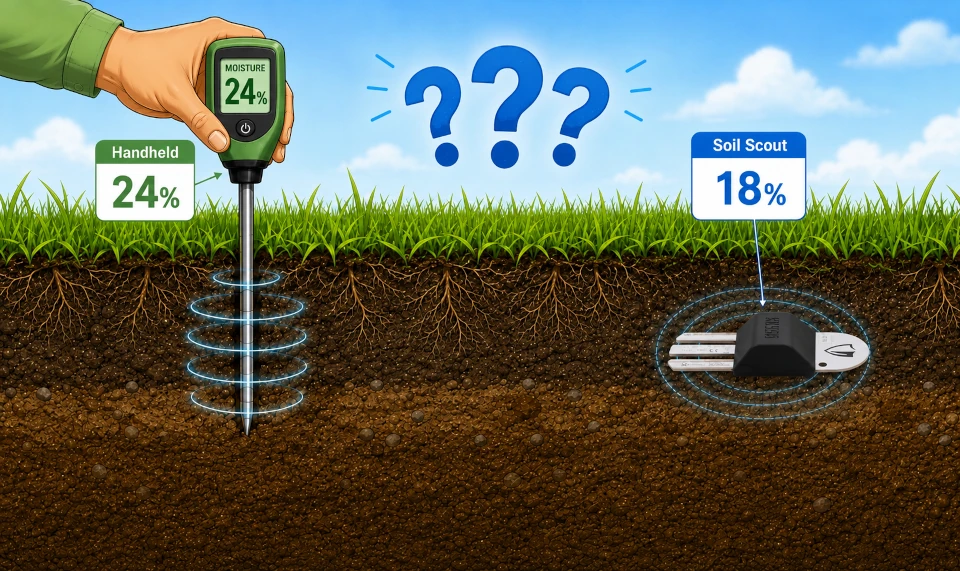
Difference between soilscout and handheld sensors
Why doesn't my handheld match my Soil Scout?
This is a common question, and it usually does not mean that either sensor is wrong.
The reason is simple: They are not measuring the same thing.
| Topic | Handheld | Soil Scout |
|---|---|---|
| Where does it measure? | Along the inserted rods | Around one fixed point in the rootzone |
| What does the number represent? | Integrated moisture across the probe length | Moisture around the sensor at its installation depth |
| Measurement style | Manual snapshot | Continuous measurement |
| Best used for | Comparing different areas of a green | Following what happens at one location over time |
| Typical question answered | “Where is it wetter or drier?” | “How is the rootzone changing?” |
Why can the numbers be very different?
Imagine a 12 cm handheld probe inserted into a profile where:
- the top is relatively wet (0 to 5cm),
- the middle is moderately moist (5 to 8cm),
- the deeper rootzone is considerably drier (8 to 12cm).
The handheld combines information from across that profile into one reading. A Soil Scout installed at 10 cm, however, measures the conditions surrounding that specific location.
So the handheld might read 25% VWC while the Soil Scout reads 15% VWC. That difference is real, the instruments are simply measuring different things.
Further reading
- >Ferré et al. (1996) – Spatial Averaging of Water Content by Time Domain Reflectometry
Explains how TDR integrates soil dielectric properties along and around the probe. - Noborio (2001) – Measurement of soil water content and electrical conductivity by time domain reflectometry: a review
A useful overview of how TDR determines soil moisture from electromagnetic measurements.
Thank you! Your submission has been received!
Oops! Something went wrong while submitting the form.
